
Hurricane Roof Upgrades by Weak Point

Roof-to-wall straps and clips
The connection between the trusses and the walls is what keeps the roof on the house when wind pulls up on it. The wind mitigation form grades that joint, with plain toenails at the bottom of its scale. A retrofit adds clips or wraps at each truss. In Pompano Beach this comes up on every re-roof, because the city's Roofing Affidavit makes the contractor's qualifier pick one of three answers:
- Existing straps comply. Broward's Board of Rules and Appeals treats steel straps at least 1/8 inch by 1 inch, fastened with three 16d nails, as meeting the 500-pound uplift minimum.
- Retrofit required. The strapping has to be done by a licensed general, building or roofing contractor.
- Retrofit not required. The building is valued under $300,000, or the retrofit would add more than 15% to the re-roof cost (with a cost estimate attached).
Florida law puts roof-to-wall work inside a roofing contractor's scope (what that scope covers).

Secondary water barrier
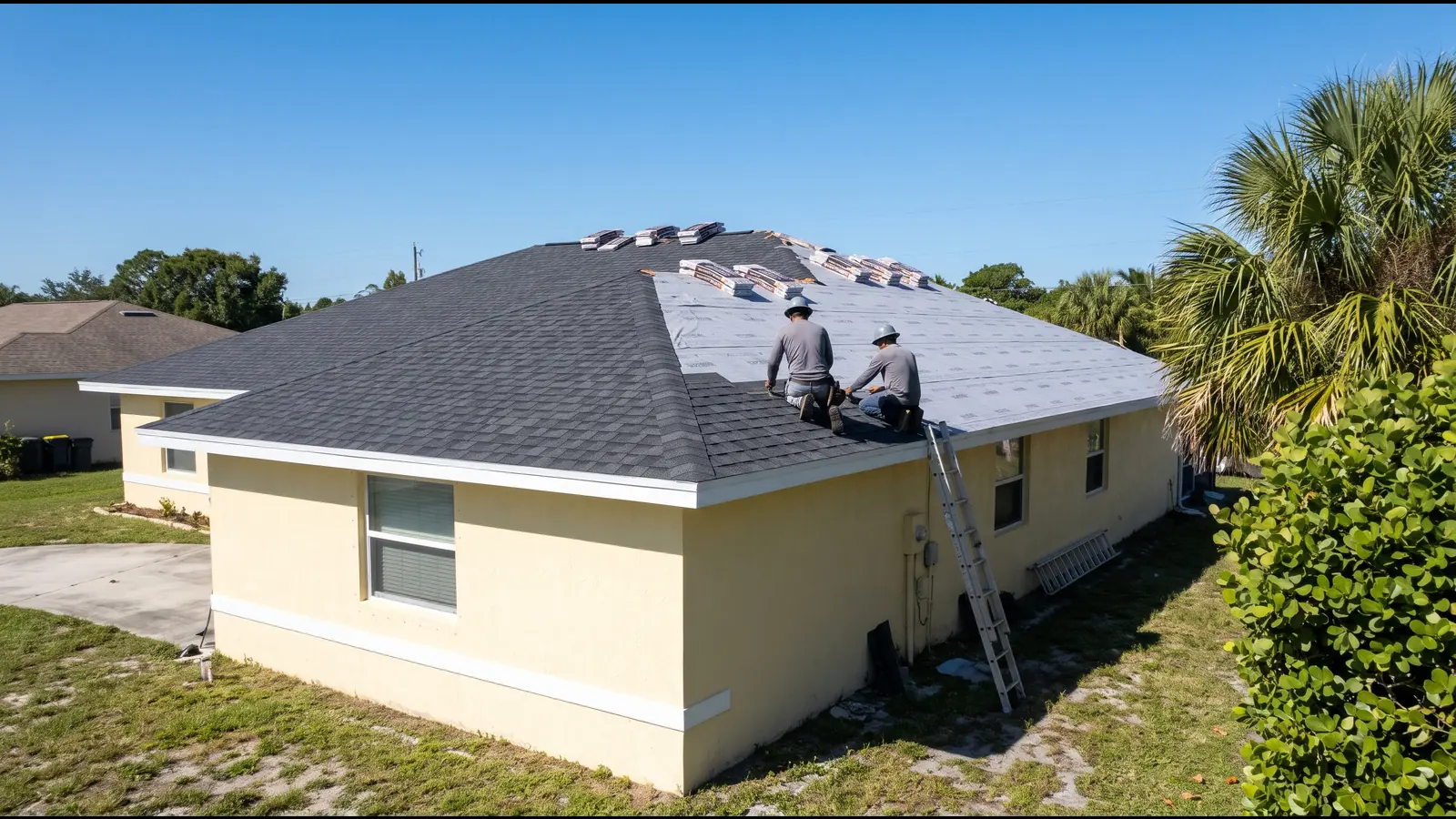
If wind strips the covering, a sealed deck is what keeps rain out of the attic. FEMA's guidance after Hurricane Michael says this kind of secondary barrier can greatly reduce water getting in once the roof covering is lost or punctured. In the HVHZ, shingle and metal roofs on slopes of 2:12 or more already have to use one of three underlayment methods:
- Full peel-and-stick: ASTM D1970 self-adhering membrane across the whole deck
- Taped joints: a strip at least 3 3/4 inches wide on each plywood joint, then a full layer of approved underlayment on top
- Double layer: two plies of rated felt or synthetic, each lapped just over half a sheet
Without a re-roof, the state grant guide describes foam adhesive sprayed onto every seam and joint from the attic side.

Deck renailing
The insurer form grades the deck by nail size and spacing, and the upgrade is more nails, or longer ones, into each truss. It is done when the old covering is off, and the roof deck replacement page explains when renailing becomes part of a re-roof and what the permit form asks the owner to accept.

Gable-end anchoring
Gable ends get priority in the code's retrofit rules. On a house with both hip and gable ends, the gable-end connections come first unless the hip end is more than 1.5 times wider. The prescriptive method checks each truss or rafter within 6 feet of the corners on both sides of a gable end. Where a strap is missing, or has fewer than four fasteners on each end, it calls for a strap, tie or bracket rated for at least 500 pounds of uplift. If 15% of the re-roof cost can't cover the gable ends or all corners, the retrofit isn't required at all.
Why Pompano Beach homeowners call Pompano Beach Roofers
- Calling or sending the form costs you nothing
- Your request goes to one roofer, not a list of bidders
- Ask for tear-off, deck work and the permit on one itemized quote
- Get the roofer's CC or RC license number and check it yourself
My Safe Florida Home Grants for Roof Upgrades
The state program has paid two-thirds of approved hardening work, up to $10,000 (eligibility basics). The roof rules in its 2025-26 guide matter most here:
Whole roof only
Patching and partial repairs aren't funded. A new covering qualifies only when the entire contiguous roof is replaced with a secondary water barrier.Every truss
Roof-to-wall credit needs connectors on every truss or rafter in the house.Home value
Grants require an insured value of $700,000 or less.Approval first
The grant has to be approved before work begins, so a job started early won't qualify.
See wind mitigation and 4-point inspections for the form that records these upgrades.