
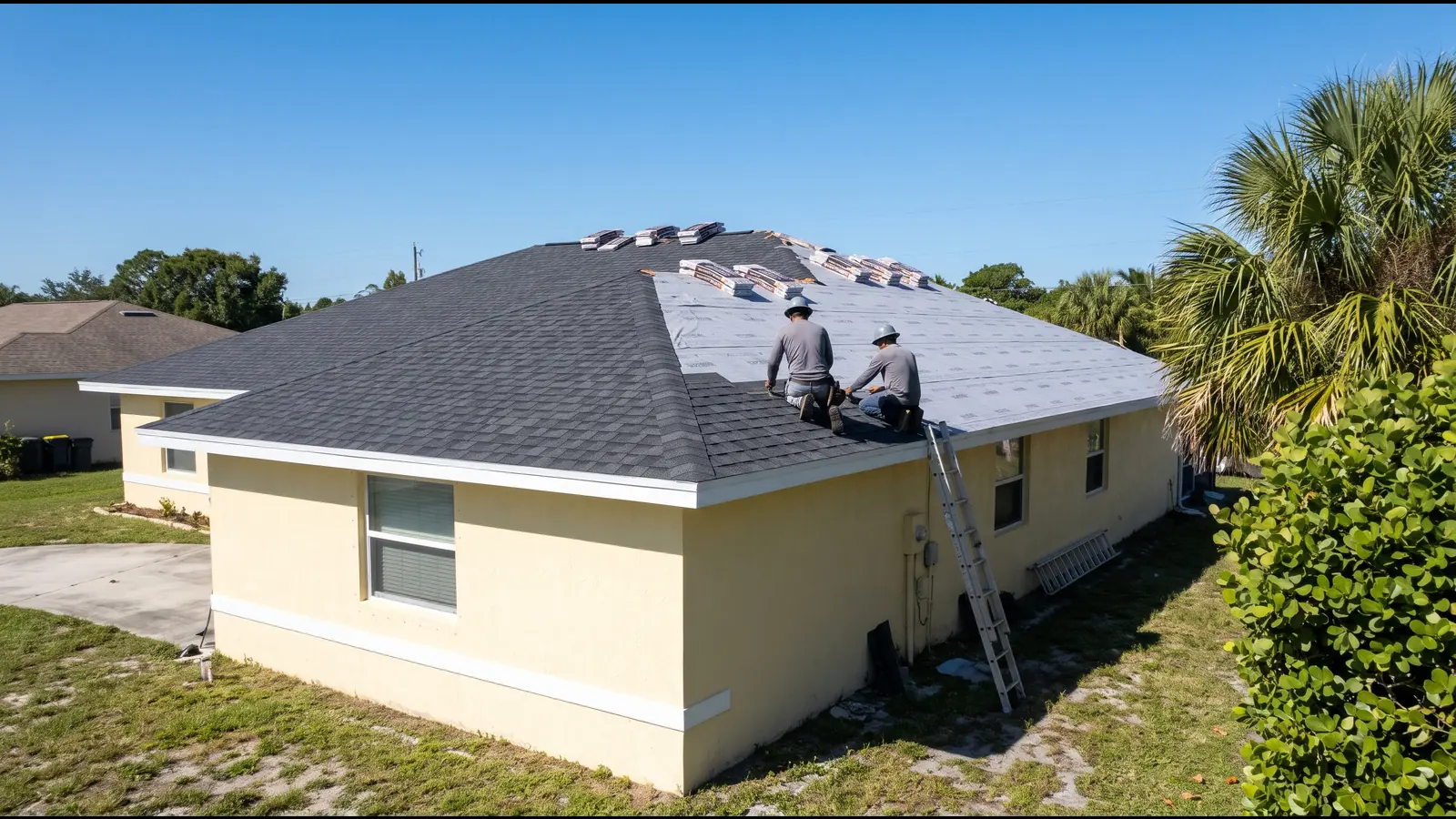
Commercial Roofing Jobs by Building Type

Retail Plazas and Office Buildings
A strip plaza is usually one long low-slope roof shared by several tenants, with a parapet on the parking-lot side and the drains or scuppers along the back. Drainage is where the HVHZ code is strict. When a plaza roof is repaired, recovered or replaced, the number and size of its required drains and scuppers can't go down unless a registered design professional designs a new drainage system. Where a parapet would trap water if a drain clogs, overflow drains or overflow scuppers are required:
- Overflow inlet: 2 to 4 inches above the low point of the finished roof, sumps excluded
- Overflow scupper size: at least 4 inches in any dimension, lined with approved metal
Membrane choices and tear-off versus recover are covered on flat roof replacement.

Restaurants with Rooftop Units and Kitchen Exhaust
Grease is the restaurant roof problem. An article in NRCA's Professional Roofing magazine quotes industry sources saying fats and oils make most membranes soften, delaminate, blister or crack, and can put a manufacturer's warranty at risk. NFPA 96 calls for the exhaust termination to drain grease into a closed, noncombustible, rainproof container. The same article suggests walking the roof quarterly to check every unit that emits grease. Ask what the roofer plans to put under each exhaust fan. Every rooftop unit in the HVHZ has these rules:
- No wood sleepers under rooftop equipment
- Leg heights by unit width: 14 inches up to 24 wide, 18 inches for 25 to 36, 24 inches for 37 to 48, 30 inches for 49 to 60, and 48 inches for 61 and wider
- Conduit and piping at least 8 inches above the finished roof
- Condensate lines may not drain onto the roofing

Warehouses and Metal Buildings
Many warehouses sit on corrugated steel decks, and the HVHZ code treats those carefully before a new roof goes over them. The deck has to be examined for corrosion first, and any rust exposed on the roof side gets a rust inhibitor. A steel deck lighter than 22 gage must be field tested for fastener withdrawal resistance before the new system is applied, with the results filed alongside the uniform roofing permit application. Ask whether the quote includes that test. Metal panel systems for the roof itself are on metal roofing, and coatings for a sound metal roof on roof coating.

Churches and Schools
The code designs these buildings for more wind. Table 1604.5 places a building whose main use is public assembly with an occupant load over 300, and a school (Group E) with more than 250 occupants, in Risk Category III. Broward's design wind speed for Category III is 180 mph, compared with the 170 mph that applies to houses (see hurricane roof upgrades). Many also join a steep sanctuary or classroom wing to a flat hall, and Pompano Beach's HVHZ permit form takes separate sections for low-slope, shingle, tile and metal roofs.
Why Pompano Beach homeowners call Pompano Beach Roofers
- Calling or sending the form costs you nothing
- Your request goes to one roofer, not a list of bidders
- Ask for tear-off, deck work and the permit on one itemized quote
- Get the roofer's CC or RC license number and check it yourself
What Changes the Price of a Commercial Roof
The deck
Lightweight insulating concrete, gypsum and cementitious wood fiber decks need a TAS 105 fastener withdrawal test. If the fasteners hold less than 80% of the value in the product approval, a structural engineer has to specify the attachment before the permit is issued.Wet insulation
A recover over the old membrane needs a moisture survey first. Wet layers mean a tear-off; the limits are on flat roof replacement.Equipment that has to move
Each unit lifted to roof under it must go back on supports that meet the leg-height table, so count the units before comparing quotes.Drains and scuppers
Adding overflow scuppers through a parapet, or re-lining old ones with metal, is a line item of its own.
The referral is a single roofer, not a bidding list, so a second bid or the building's own roof consultant is the best check on that price.
See TPO roofing for the single-ply membrane most plaza and warehouse roofs use.